The short answer
How do I tune a guitar by ear without a tuner?
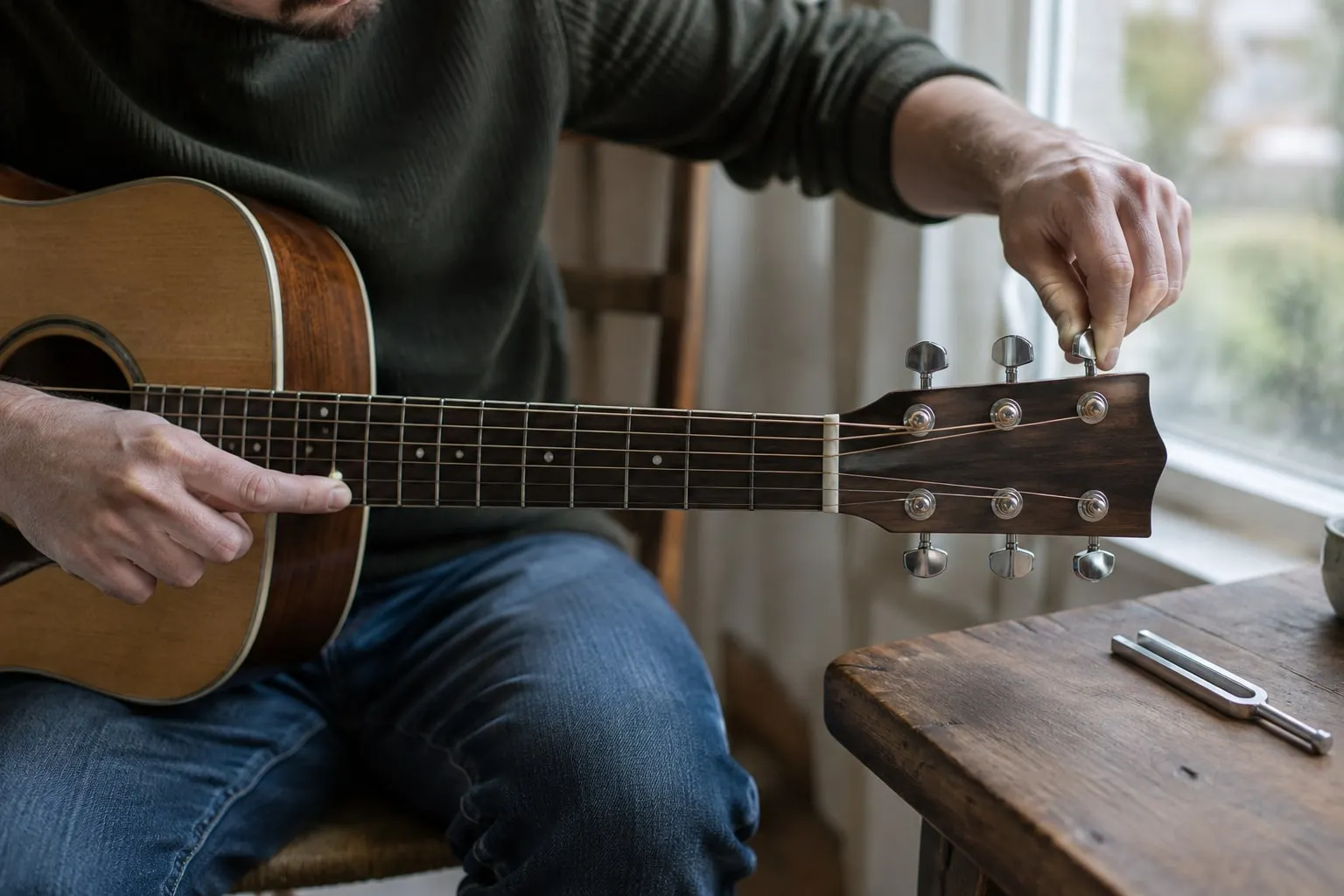
Tune one string to a reference such as a piano or an A 440 tuning fork, or to a low E that sounds firm and clear. Then fret each string at the fifth fret and match the next open string to it, using the fourth fret on the G string to tune the B. Play both notes together and turn the peg until the pulsing between them slows and stops.
What we found
- Tuning by ear relies on matching pairs of notes and listening for beats, the pulsing sound two nearly equal pitches make.
- The beat rate equals the difference in frequency, so slower pulses mean you are closer.
- Every neighboring string matches at the fifth fret except G to B, which matches at the fourth.
- Harmonics ring purely and are easier to compare, but chained harmonic fifths can leave a string about two cents sharp.
- Raising each string up to pitch from below keeps the gear and nut from letting it slip flat afterwards.
The tuner app will not open, the clip-on battery has died, or you have simply picked up a guitar at a friend's house with nothing but your hands and your ears. Most players in that position twist pegs until it sounds roughly right, then wonder why every chord has a faint sour edge. The guitar is in tune with nothing in particular, and the strings disagree with each other in small ways that add up.
Tuning by ear is not a gift reserved for people with perfect pitch. It is a short, learnable routine built on two ideas: the strings overlap, so one string can serve as the reference for the next, and two notes that are almost the same make a pulsing sound you can learn to hear and slow down. Once you know where to listen, you can tune a six-string guitar in about two minutes, and you will notice when it drifts long before a tuner would have told you.
Start with one string you trust #
Relative tuning makes the guitar agree with itself; it does not set the overall pitch. That is perfectly fine when you play alone, but if you will play with a piano, a recording or another guitarist, you need one note from outside. Standard tuning, from the thickest string to the thinnest, is E, A, D, G, B, E, and the open fifth string is the A two octaves below the A at 440 hertz that most of the world treats as concert pitch.
Any trustworthy source can give you that first note. A piano or keyboard is the easiest: play the A below middle C and match the open A string to it. A tuning fork marked A 440 is cheap, needs no battery and lasts a lifetime; strike it on your knee, touch the base of the stem to the guitar top, and compare it with the high E string fretted at the fifth fret, which is that same A. If you are joining other musicians, take the note from whoever cannot easily retune, usually the keyboard or the bass.
Learn to hear the beats #
When two notes are close but not identical, their sound waves drift in and out of step, and you hear the combined tone swell and fade: a slow wah, wah, wah. Those pulses are called beats, and their speed equals the difference between the two frequencies. If one string is two hertz away from the other, you hear two pulses a second; at half a hertz, one slow pulse every two seconds. When the notes match, the pulsing stops and the sound becomes smooth and still.
This is the whole secret of tuning by ear. You are not trying to judge whether a note is high or low in the abstract; you are listening for the wobble and making it slower until it disappears. Turning the peg the wrong way makes the beats speed up, which tells you instantly to reverse. Many beginners hear the beats clearly once they know they exist, especially on the low strings, where the pulses are slower and easier to follow.
A practical habit makes everything easier: always approach the target pitch from below. If a string is sharp, drop it slightly below the note and bring it back up. Tightening last pulls the string snugly through the nut and takes up the slack in the tuning gear, so the string stays where you leave it instead of creeping flat a minute later.
The fifth-fret method, string by string #
Most of the guitar's neighboring strings are tuned five frets apart, so a note fretted at the fifth fret on one string is the same pitch as the next string played open. The one exception is between the G and B strings, which sit four frets apart. Play the fretted note and the open string together, let both ring, and adjust the open string until the beats vanish.
Set the low E or the A
Tune your reference string first. If your note came from a piano or fork, start with the A string; otherwise start with the low E. Then check the low E against the A, fretting the low E at the fifth fret and adjusting the E if needed.
Tune the D string
Fret the A string at the fifth fret and play it with the open D string. Listen for the pulsing and turn the D peg until it slows and stops. Remember to come up to pitch from slightly below rather than easing down from above.
Tune the G string
Fret the D string at the fifth fret and match the open G to it. The pitches are higher now, so the beats are quicker; let the notes ring a full two or three seconds before deciding which way to turn the peg.
Tune the B string at the fourth fret
This is the step people get wrong. Fret the G string at the fourth fret, not the fifth, and match the open B string to it. Using the fifth fret here leaves the B a half step out, and every chord will clash.
Tune the high E
Fret the B string at the fifth fret and match the open high E. Thin strings break most easily, so turn slowly, keep your face away from the headstock while you raise the pitch, and stop if the string feels much tighter than the others.
Check across the neck
Play the low E open against the high E open: they are two octaves apart and should sound calm together. Strum an open E major and a G major chord. If one string stands out, retune that string against its neighbor.
The weakness of the fifth-fret method is that each string inherits any small error from the one before it, and fretting itself can push a note slightly sharp if you press hard or the guitar's intonation is a little off. By the time you reach the high E, small errors can stack. Press just behind the fret with light pressure, and if the top strings sound off against the low ones, check them with harmonics instead.
Tuning with harmonics for a cleaner match #
A harmonic is the bell-like note you get by touching a string lightly, directly above a fret wire, without pressing it down, then plucking and lifting the finger. At the twelfth fret it sounds an octave above the open string, at the seventh an octave and a fifth, and at the fifth fret two octaves. Because harmonics ring purely and are not affected by fretting pressure or intonation, the beats between them are easier to hear, and they keep ringing while both hands are free to turn the peg.
| Touch lightly | Compare with | Tunes |
|---|---|---|
| Low E, 5th fret | A string, 7th fret | A string |
| A string, 5th fret | D string, 7th fret | D string |
| D string, 5th fret | G string, 7th fret | G string |
| Low E, 7th fret | Open B string | B string |
| A string, 7th fret | Open high E | High E |
There is one subtlety worth knowing. A guitar's frets are placed for equal temperament, which makes each fifth very slightly narrower than the pure fifth a harmonic produces, by about two cents, a fiftieth of a half step. Matching harmonics chained across several strings can therefore leave a string a hair sharp. It is too small to matter for most music, but if the B or high E sounds a touch bright in open chords after tuning with harmonics, nudge it down a whisker until the chord settles. The same effect is part of why a guitar can sound out of tune even when a tuner says it is fine.
Final checks that catch what single strings miss #
Once each string has been tuned, test the guitar the way you will use it. Octaves are the clearest check: the D string fretted at the second fret is an octave above the open low E, and the A string at the seventh fret sits exactly an octave below the open high E. Then play a few open chords that use every string, such as E major, A major and G major, and listen for one note that seems to stick out or shimmer. Fix that string against a neighbor you trust and play the chords again.
Expect to go round twice the first time you tune a guitar that was well out. Raising several strings increases the pull on the neck, which can lower the strings you already set by a little. New strings stretch for days, so they need extra rounds as well; if a whole set keeps slipping flat no matter what you do, check whether it is time to change strings that are worn out or simply give a fresh set time to settle. A guitar that buzzes after a big tuning change may have a neck that moved with the tension, and our guide to why a guitar buzzes on certain frets walks through what to check.
Training your ear so tuning gets faster #
The first few sessions can feel slow because you are learning to separate two notes that blur together. A few habits speed this up. Hum the reference note before you play the string you are tuning; your voice settles on the pitch, and you will hear more clearly whether the string is above or below it. Mute the other strings with your palm so only the two notes you are comparing ring. And tune in a quiet room for the first week, away from a fridge, a fan or the television, whose own hum can mask the slow beats you are listening for.
Make tuning by ear part of every practice session #
For the next two weeks, tune by ear first and only then check yourself with a tuner if you have one. Note which strings you got wrong and in which direction; many players find they leave the same string a little off every time, often the B, and once you see the pattern it corrects itself quickly. Before long you will tune by ear in well under two minutes, catch a string drifting in the middle of a song, and use a tuner only to confirm what you already heard. That is what fluency sounds like.
Take this with you
Key takeaways
- Choose one reference note, from a piano, a tuning fork or a firm low E, before you touch the other pegs.
- Listen for the pulsing between two notes and slow it down until it disappears, rather than judging pitch alone.
- Use the fifth fret for every pair except G to B, which uses the fourth.
- Switch to harmonics when the top strings sound wrong, and nudge the B down slightly if chords sound bright.
- Tune by ear before checking with a tuner for two weeks to learn which strings you tend to get wrong.
Questions readers also ask
Can I tune a guitar to a song or a recording?
Yes, as long as the recording is at standard pitch, which most modern music is. Find a passage where a clear open-sounding E or A note rings, pause or loop it, and match your open string to it by listening for beats. Older recordings, some live albums and bands that tune down a half step will not match standard pitch, so confirm with a second song.
How do I tune a guitar in drop D by ear?
Tune to standard first, then lower only the low E string. Play the open D string and the low string together; the low string should sound exactly an octave below. Lower it until the pulsing between them stops. A quick check is the twelfth-fret harmonic on the low string, which should match the open D string exactly.
Does tuning by ear work on a classical guitar with nylon strings?
The method is identical, using the same fifth-fret and fourth-fret pairs and the same harmonics. Nylon strings stretch far more than steel, though, so new nylon strings can take a week or more to settle and will need retuning several times in a single session. Their softer, rounder tone also makes beats a little gentler, so let each pair ring longer before you judge it.
What does it mean if a string is in tune open but out of tune when fretted?
That usually points to intonation rather than tuning. The saddle position, string height and string age all affect whether fretted notes stay true further up the neck. Compare the twelfth-fret harmonic with the twelfth-fret fretted note: if the fretted note is sharp or flat, the guitar needs an intonation adjustment, which a repair shop can do as part of a setup.
Is perfect pitch needed to tune by ear?
No. Perfect pitch is the rare ability to name a note without any reference. Tuning by ear uses relative pitch, comparing one note against another, which almost anyone can develop. Hearing beats between two nearly matching notes is a physical effect rather than a talent, and most people learn to hear it within a few practice sessions.
How do I tune a twelve-string guitar by ear?
Tune the six main strings first using the usual method. Then tune each paired string to its partner: the higher-octave strings on the lower four courses should sound exactly an octave above their partners, and the top two pairs are unisons. Play each pair together and remove the beating. Take extra care with the thin octave G, which breaks easily.
How we made this. Every piece in the archive is researched and written by the editorial desk, then checked against our editorial standards. We do not publish medical, legal or financial advice. Spotted something we got wrong? Tell us, we correct in public.